

COMPANY: Hoare Lea
PROJECT: GRE at Cambridge Airport
SPONSOR: ANV Measurement Systems
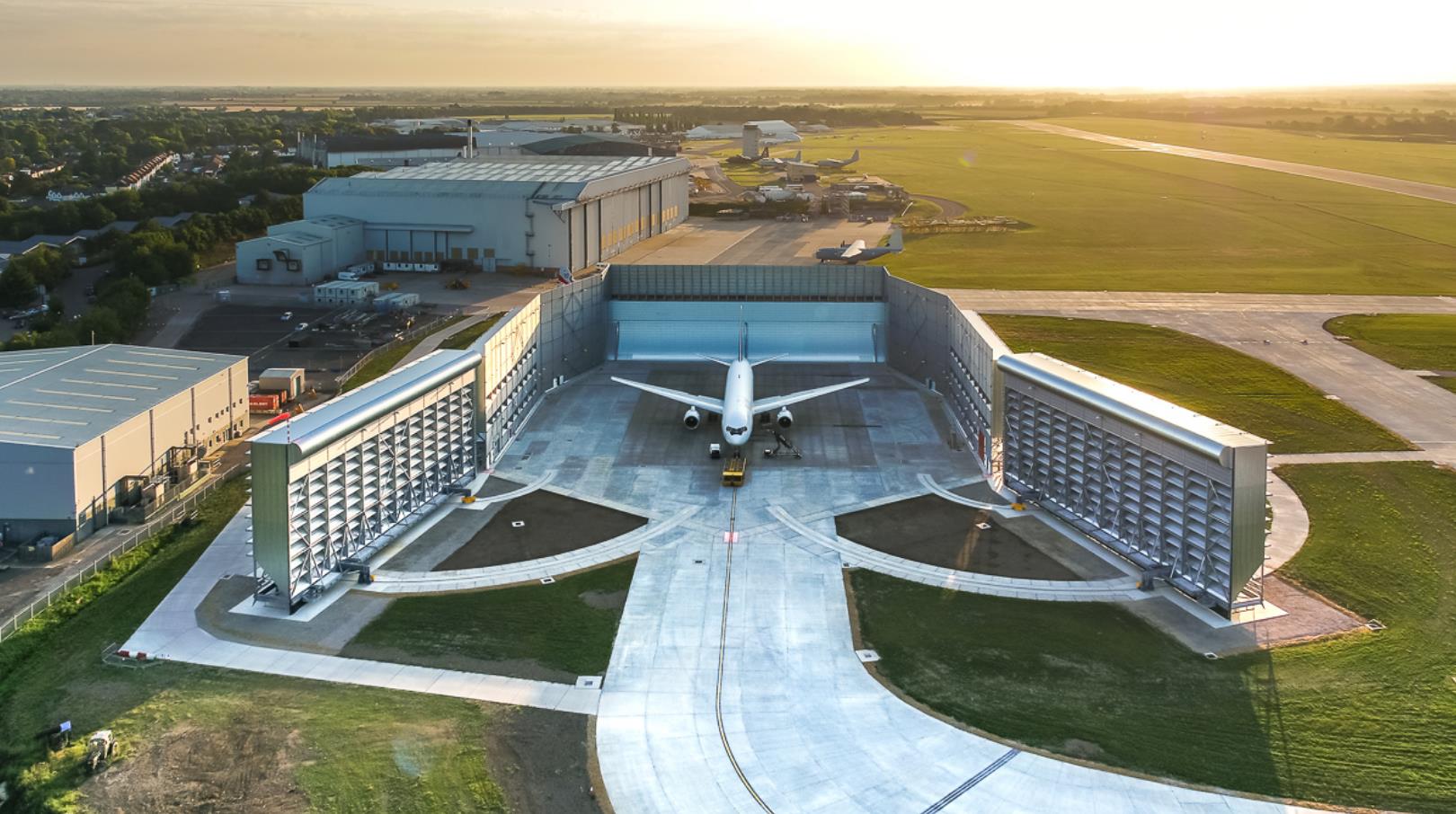
The bespoke £20M ground run enclosure (GRE) at Cambridge Airport was built to allow the relocation of aircraft engine ground running from an existing open-air facility. This was a consent condition for 1,300 homes on adjacent land, and enabled consent for a further 1,200 homes. In addition, the provision of this facility substantially improves the acoustic environment for thousands of people including residences, schools, colleges and green space, whilst also releasing (non- greenbelt) land to meet the increasing housing and community development requirements. With a height of 20m and internal dimensions of ~75m by ~90m, the GRE is one of the largest such acoustic enclosures in the world.
Notwithstanding its clear acoustic benefits, the development came under intense planning scrutiny. To assist, the consultation process included developing a highly visual auralisation tool to enable subjective evaluation of effects. Further bespoke system developments were required to deliver the extensive noise commissioning requirements, which had to be undertaken in an operational airfield.
The methodology and equipment evolved significantly requiring: strict health & safety, coordination and communication protocols between the 50+ operatives required; engineered monitoring stations, with duplicate Sound Level Meters at both 1.5m and 4.0m heights; in-house developed software enabling full central control and real time access to all 21 systems and data, live comparison of measured levels against the target noise limits, and hard-wired ethernet communication links between all systems and the vehicle-based central station.
An innovative noise measurement solution was needed to minimise the closure of the airport whilst guaranteeing 100% data capture. The resultant system combined speedy deployment with robust, real-time communications and data management via centralised control. Upon completion of the testing, compliance with the target noise levels for both aircraft was achieved.
JUDGES’ COMMENTS:
This project impressed the judges in its size and complexity. It was technically challenging, seeking to solve a difficult problem with a clear explanation of how this had been undertaken including overcoming, at the time of commissioning, the sudden lack of aircraft availability. As the work is complete, the solution has been proven to work, something which reassures judging panels when considering all projects. It was creative with good use of modelling and some innovative techniques have been utilised.
FURTHER INFORMATION:
The brochure entry for this project can be found here and the video is available here.